
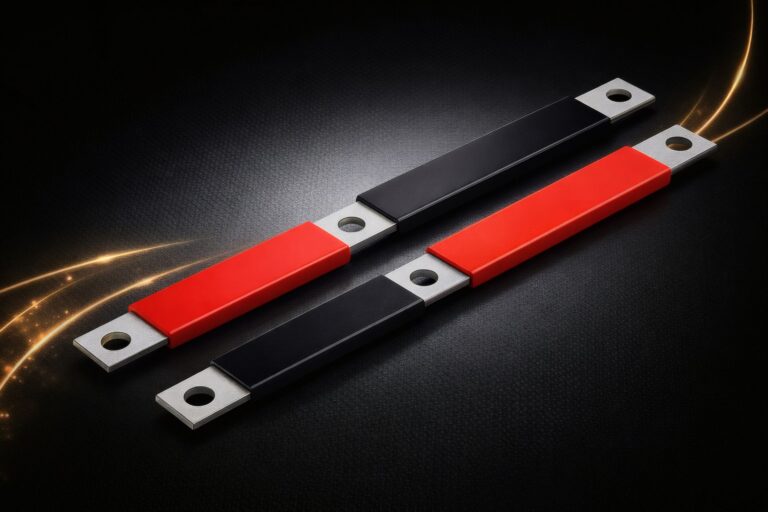
 A busbar is easy to draw and hard to insulate well. Sharp stamped edges, bolt pads that have to stay bare, plating that limits how hot you can take the part, and a bend that puts the film in tension right where you need it thickest.
Most programs start with heat shrink sleeving, tape, or a molded cover. All three add bulk you cannot control tightly. Fluidized bed epoxy lays down a uniform film, typically 10 to 20 mils (250 to 500 microns), that follows the bends and the edges. On a bar that has to clear its neighbor by a few millimeters, that is the whole packaging argument.
The dielectric numbers are simple. Engineered dielectric powders run roughly 800 to 1,500 volts per mil (31 to 59 kV/mm), so a 12 mil (300 micron) film clears an 800V pack with room to spare. The value is set at the thinnest point, though, and on a busbar that is a stamped edge or the outside of a bend. That is where we measure.
Two things to settle early. Masking has to leave contact pads and threads completely clean with a sharp coating edge, so send the pull-back dimension with the print. And plating sets the ceiling, since fluidized bed dipping preheats the bar well above cure temperature and tin has a real limit.
Wright Coating Technologies runs fluidized bed and electrostatic lines in Kalamazoo. Send us your busbar prints and we will tell you what film you can hold.